
Measuring pack-out for collapsible rigid boxes
A fold-flat box can take up a different amount of space before and after assembly. To compare delivery formats, measure the sealed outer cartons for the same order and include every separately packed component.
Pack-out means how boxes, inserts and accessories are arranged and counted in their shipping cartons. If you do not have a packed sample yet, share the intended format and mark dimensions as estimates.
Discuss my packing format ↗︎Choose the same delivery stage
Decide what the packing team will receive: empty flat boxes, assembled empty boxes, or boxes already fitted with inserts. Identify who assembles them and who packs the products. Compare the same number of complete packaging sets at the same stage.
Keep the later shipment of filled products separate from the delivery of empty packaging. A reduction in empty-box volume does not establish the space or protection needed for the packed product.
Measure a packed, closed outer carton
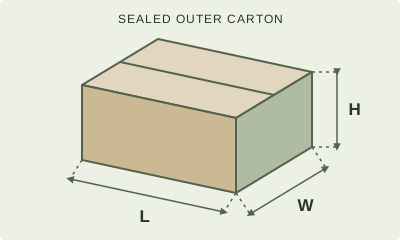
- Pack the intended contents. Include wraps, separators and protective materials. Count the units actually inside and identify the packing revision.
- Close it as it will ship. Measure outside length, width and height at their greatest extent. Record the unit; do not substitute the flat box footprint or the carton’s nominal inside dimensions.
- Weigh the complete carton. Record gross weight with contents and packing materials, and note the weight unit.
- Keep a reference. Photograph the arrangement before closing and the measurements after sealing. Mark whether the values are measured or provisional.
Count a complete packaging unit consistently: for example, one box with its lid where applicable. State whether the insert is included or packed elsewhere. If the load is palletised, record the complete pallet’s outside dimensions and gross weight separately rather than treating carton totals as the pallet envelope.
Give each different carton its own record
Use separate rows for box cartons, insert cartons and accessory cartons. For each row, record contents, pieces per carton, carton count, outside dimensions and gross weight. Check that the total quantity of every required component covers the same order.
A partly filled final carton still occupies its full outside volume. If it uses a smaller carton, measure and record that carton as a separate row. Do the same for mixed carton sizes; one average size can hide the actual packing arrangement.
A worked volume check
Hypothetical numbers for explaining the method, not measured YDP packing data: an order contains 500 boxes, packed 80 per carton. Each outer carton measures 500 × 400 × 300 mm.
- 500 ÷ 80 = 6 full cartons plus one carton holding the remaining 20 boxes: 7 cartons.
- One carton: 500 × 400 × 300 ÷ 1,000,000,000 = 0.060 m³.
- If all seven cartons use that size: 7 × 0.060 = 0.420 m³.
- If the 500 inserts ship in five additional cartons measuring 400 × 300 × 200 mm, add 5 × 0.024 = 0.120 m³.
- Total outer-carton volume for these two groups: 0.540 m³. Add any other component cartons to this total. Measure a loaded pallet separately if used; do not add its envelope volume to the cartons it contains.
The outer-carton volume tool handles one carton size and pieces-per-carton value for each alternative, rounding the last carton up to a full carton of that size. Record separate component groups and mixed carton sizes outside that result; the tool does not combine them automatically.
Use volume as one input to the decision
Gross weight, the transport service, destination, packing requirements and assembly work also matter. Carrier dimensional-weight rules are separate from cubic volume. A percentage change in volume is not a freight-price or cost-saving percentage.
Trial the assembly with the intended team and components. Record the work steps and unresolved handling questions. A successful assembly or volume measurement does not prove transport protection; agree the relevant sample and shipping checks for the product.
Send a packing brief you can trace
- Order and stage: complete packaging quantity, delivered format and assembly owner.
- Each carton group: contents, units per carton, carton count, outside dimensions with units and gross weight.
- Exceptions: final cartons, separate inserts/accessories and any pallet details.
- Evidence: packing photos, measurement date and measured or estimated status.
- Next step: destination, target arrival and questions to review.
Download the packing measurement worksheet (TXT) ↓
No email needed. Use it for working notes, then copy the useful details into your inquiry; reference images or a PDF can be attached.
Return to collapsible rigid boxes to review the delivery options. Unknown measurements can stay open while the proposed packing arrangement is developed.
Review my packing measurements ↗︎